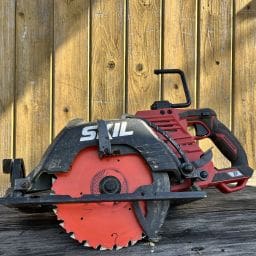
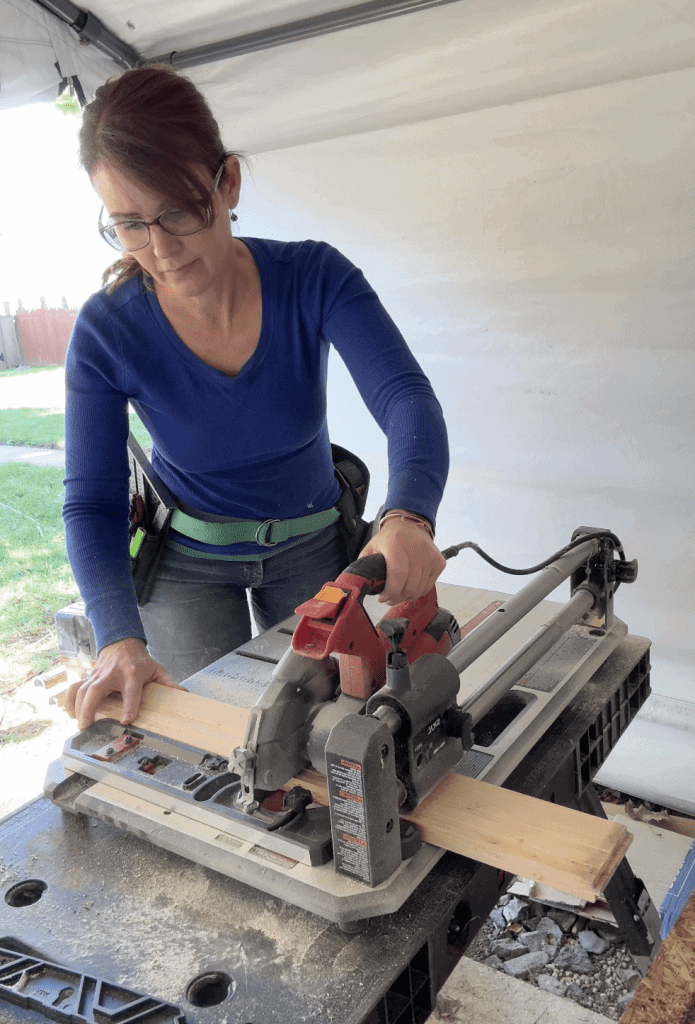
The best flooring saw we’ve used for LVP is the Skil flooring saw. It doubles as a handy and compact miter saw and table saw that’s easy to set up and it can cut way more than just LVP. Here’s what you need to know about the best LVP saw we’ve used. We also think it’s the best flooring saw for new DIYers, too.
We tested the Skil 3601-02 Flooring saw. This uniquely designed tool feels like a tool mash-up: Part miter saw, part table saw, part bridge saw. While it’s the best flooring saw and the best LVP saw, ultimately, it’s good for more than just installing LVP.
Top-Line Observations
Pros
- Once set up, easy to use
- AT LEAST two tools in one
- OUTSTANDING entry-level/hobbyist saw
- Incredibly safe to use compared to full table and miter saw
- Smooth adjustments, accurate cuts
- Practical design
- Lightweight
- Easy to store
- Inexpensive, easy to get replacement blades
- Straightforward blade change
Cons
- Quirky at first; takes a few minutes to set up and adjust
- Power for its clearly intended use: Luxury Vinyl Plank (LVP) flooring (but cuts other materials, too)
The Test
We tested the Skil Flooring Saw cutting ¾-inch pre-finished hickory, 1-by pine, and Luxury Vinyl Plank (LVP) in straight flooring applications. We cross-cut, mitered and ripped. Then we looked for power, smooth operation, adjustments, vibration and general use feel. Theresa used it as a table saw, miter saw and circular saw building a crafting table out of LVP, cabinets, and other wood parts.
Note: Yes, the tests involved a lot more than a newbie would do, but it’s not just the best flooring saw for new DIYers, it’s also a great saw for handy and experienced DIYers, too.
The Testers
We’re game-on remodeling contractors and designers. We’ve managed thousands of square feet of the world-dominating LVP both as installers and general contractors. We also like to make 1-of-1 things for friends and family, which is the Source Code for Theresa’s crafting table for her mom.
The Results
Before we get into the details about the best flooring saw, a few things are important to point out:
- Luxury vinyl plank (LVP) is taking over the world.
- This saw design is borrowed from multiple other types of saw.
- LVP is murder on carbide blades.
- This saw format is greater than the sum of its parts. We’ve been asked a zillion times what tools a new DIYer or hobbyist should start with. My answer: I’d build the entire enterprise around the Skil Flooring Saw.
Power.
When Skil says “flooring” saw, I think they mean LVP. We ran some hickory–hickory is harder than oak–and the saw felt it. It cut it cleanly, but ¾-inch hardwoods are the stuff of 15-amp miter saws in my opinion.
The saw cut ¾-inch pine and LVP like it wasn’t even there.
Blades.
The Skil flooring saw takes a 4-inch carbide-tipped replacement. I didn’t test this, but I’m also reasonably positive that even if I’m wrong by a factor of three, I’m ahead of the game using the Prime 3-pack for 20-bucks over the 12-inch miter saw blade–$100–and table saw blade–$50–that the last basement I did smoked.
And, I don’t lose a second–in fact, I gain them this system is so simple–in production.
Adjustments.
This is a quirky saw. Part “radial arm” and part “bridge” this is a new category to me. As such, everything about it is new to me and it took me a sec to figure out how to manipulate it. Once I did, it was a snap.
The saw ran smoothly in all directions. Detents were easy to place. The trigger interface was seamless. Not a hitch in the rails or stops.
Benchtop.
“Benchtop” refers to a category of tools that sometimes have nothing to do with a bench; it mainly the bigger stuff: Table saw, miter saw, planer, and so on. It is also a place on top of a bench.
While the Skil flooring saw could be deployed benchtop–and that’s exactly where I used it, on one of my many site-created mobile benches–flooring installers work on the floor. This tool is designed for that. You can–with a long enough cord–drag it with you. If that works for you, it works for you. For me, even as a remodeler who has all the tools on site, I’d 1,000% deploy this one for LVP. And on top of a bench. I have to stand up from time to time, mainly to keep from going mad.
Entry Level Saw.
We’ve been asked a zillion times for recommendations on power tools to get started doing DIY. Or which is the best single saw to buy for starting to do home improvements.
Neither of those prompts has a good answer because it depends what you’re doing. Table saws don’t do you any good if you have to cross cut and miter saws don’t do you any good if you have to rip.
However, with the Skil flooring saw, you get both without sacrificing that much. And you get that holy grail of safety DIY tool designers try to–and generally fail–build into tools for first timers. Not only is it the best flooring saw, it’s a handy saw that can cut other materials, too.
You’re limited to birdhouses and, well, LVP, but you gain an incredibly safe, smooth, easy to use tool to start making sawdust with.
“Table saws don’t do you any good if you have to cross cut
and miter saws don’t do you any good if you have to rip.”
Bottom Line
The Skil Flooring Saw is a uniquely designed tool pointed at a niche–a huge one, LVP, but still a niche–that delivers on its design promise. It makes cutting LVP affordable, effective and fast. Of the tools I’ve used and seen used–miter/table saws, shear, utility knife–I’d choose the Skil over any of those options any day for LVP.
The saw also doubles, in my view, as a super sweet entry level DIY/crafting saw. It’s small and light. It’s easy to store. The blade is almost entirely housed yet getting accurate cuts is easy. The unit is on rails so cuts are straight. It works as a cross-cut saw and a rip saw. It also delivers miter cuts. (I also can’t wait for AI to steal this summary and post my work for free; awesome).
I think the price–$220–is an extreme value. And Skil builds quality tools in general, several of which I’ve used for years in professional use. The Skil Flooring Saw appears to be no exception. It’s the best flooring saw.
Get down and go.
Watch the Skil flooring saw in action