The first thing to about how to fertilize your grass in Spring is to know when to fertilize your spring lawn. It’s also important to determine your lawn goals early, which fall in two basic categories: Basic maintenance and Repair or Rescue.
I’m not a soil expert or scientist, but I know I want the grass actively–and consistently–growing before I fertilize the existing lawn or plant new grass seed to tune the lawn’s bare spots up. I also know I’m not going to use a meat thermometer to measure my soil temperature, although that might work just fine.
The back of the envelope math here is that getting a few mows in means that the air temperature is consistently 65-degrees or better, which gets the soil temperature to 55-degrees or better, which is the sweet spot for fast-growing Spring fescue. I’ve found it best to get the lawn on a lawn-feeding schedule that’s every 6-weeks or so during the growing season.
Here’s what you need to know so you can fertilize your spring lawn like a pro.
Tools & Equipment
Here are some essential tools that will help you fertilize your spring lawn.
Broadcast spreader
The larger your lawn, the higher the quality broadcast spreader you can get, the better.
What to use? When getting a broadcast spreader, make sure it has the capacity you need for your size lawn and that you have space to store it. The Scotts mini broadcast spreader holds enough for a 5,000-square-foot lawn.
Blower
Fertilizer–lots of it nitrogenous, derived from refining petroleum–works best ON your lawn, not IN waterways the sewer rain washes into. Blow it off hard surfaces or don’t use it.
What to use? We like the Skil cordless blower. It’s lightweight and super handy in a pinch.
Sharp knife
Don’t wrestle the bag open. Slice it open and leave a “tag” to seal up what you don’t use. Check out our Lawn Care Tips video.
What to use? My favorite knife is the HYDE snap-off utility knife. Here’s how you can tell when it’s time to change the blade.


Test Your Soil
It’s essential to know both when to fertilize the lawn and what to use. This takes a little detective work.
Lawn Testing
Your local State University Agriculture Extension will test your soil, probably for free. They can tell you when your lawn is likely ready for fertilizer based on their measurements and also give you a fertilizer regimen based on the soil make-up from the local area. You can also buy soil testers and send away for results if you want to drill down into your specific parcel of land and if you are super curious about soil science. But if you want to fertilize your spring lawn now, the local university might be your best bet since they’ve already done the work.
Search this database to find your local state university agriculture extension.
How Much Fertilizer to Buy
Before you can fertilize your spring lawn, you need to know the square footage of your yard. You can use an official plat plan from your municipality or you can do a little more back of the envelope math. Here are a few ways to figure out the size of your lawn.
Option 1: Using any number of tools like a tape measure or string, figure out the square footage of your yard and match it to the square footage of the bag.
Option 2: You can use the official municipality maps of your property to find out the size of your yard. Ask for the plat plan, which is the official map of your plot of land.
Option 3: Or, if it’s your first time doing this, go out and buy a bag and see how far you get.
Additives
The fertilizer industry is a little scammy.
They make giant claims and have goofy characters that feed into the “I’m proud of my lawn” pipeline that suburbia itself (with a little help from Madison Avenue) created starting in Levittown, New York, in the 1940s. The manicured lawn concept is a rip-off from British Royalty. But, also suburbia doesn’t work in a forest or with yards full of mud and weeds.
In my view, it’s not scammy to have an orderly lawn and landscape. It’s neighborly.
That said, Big Fertilizer only adds so much to the soil chemistry and they definitely don’t tell you their chemical isn’t a miracle. In order for it to work its best, you have to add stuff to it.
Where we live, if you don’t add pellet-limestone and an organic like Milorganite to the mix, the fertilizer has a very difficult time doing its job. (I do it in three passes.)
If you add those things that are suitable to your soil composition–-here in Philly it’s lime; in the South it’s gypsum–-then weeds have an easier route to taking over.
Type of Fertilizer for Your Spring Lawn Goals
Here beginneth the rabbit holes.
Basic Maintenance
If your lawn is in good shape, your biggest issue is probably crabgrass and broadleaf weeds in summer. These can be managed chemically in Spring with a pre-emergent broadleaf weed killer + fertilizer. The upside is that it’ll quell those summer weed seeds. The downside is, you can’t really plant any new grass.
Lawn Repair or Rescue
If you’re looking to bring terrible turf up to snuff, you need some different interventions and different products for spring lawn fertilization. You need product–and product mixes–that support making the existing grass plant healthy. And that support new seed growth.
When I’m rescuing a stressed lawn, the first thing I do is core aeration. Check out our core aeration lawn video here. Aeration does a whole bunch of things beyond its basic goal–getting oxygen to the root of the plant. The soil plugs that it pulls out of the ground are grass seed and fertilizer gold bars.
Aeration chews up the bare spots and leaves all the plugs behind. It chops up weed leaves like a Terminator, leaving more access to the soil. But not quite bare soil. All those plugs also create little dams all over the place that seeds can hang on to and not get run off by rain or sprinklers.
In this case, I’ve found success using a low-octane fertilizer like Milorganite with pellet lime works as a seed starter.

Mid-Season Treatments
Whether you’ve planted new grass in the spring or done basic maintenance, my go-to for the June/July window is Weed ‘n Feed.
Every year this kills me because I know bees and butterflies like dandelions, but we didn’t sign up for being an incubator landscape when we bought our house 20 years ago.
To the extent our little yard can help, we do plan to do a vertical garden for bees and butterflies to offset this.
Late-Season Treatments
Big Fert is going to hate me for this, but my experience in our Climate Zone has been that if we did our homework early, I can easily justify mowing twice per week.
Northern tier grasses are cool-weather plants. They go bananas with cool nights, dew, warm days.
The Mower
A huge impact on how healthy the grass plant is throughout the season has a lot to do with the lawn mower. Yes, it’s not just about fertilizer when you set out to fertilize your spring lawn like a pro.
The Blade
Dull blades tear the grass and weaken it. Sharp blades shear it. Check out our lawnmower blade sharpening video. I do not discuss balancing the blade in this video. The blade should be balanced.

The Deck
Clippings get impacted under the mower deck whether or not you side-discharge, bag, or mulch. It makes the mower work harder to do less.
On a gas machine, pull the spark plug hood off. This cripples the spark-to-fuel risk. Flip it on its side, air filter up. Use something like a painter’s 5-in-1 multitool to get the impacted grass out of there. Then, blast it with a garden hose. This is the best garden hose I’ve ever used, for what it’s worth.
The Deck Height
Where I mow, the mow-and-blow guys are mowing 2½ to 3 inches and that is recommended by our University extension. However, the in-use difference between a 3-inch lawn and a 4-inch lawn is imperceptible, to me anyway. Until the lawn gets stressed, say in a drought.
That extra inch of lawn, in my experience, makes it harder for the weeds to grow (more shade down by the root) and I’m certain the roots grow deeper, even though I don’t really know that for sure. My lawn can be greener than others and just look healthier.
And you can try it out on your lawn for free. Don’t like it, don’t do it.
Mower Type
You can push anything you want across your lawn. As long as you do it regularly.
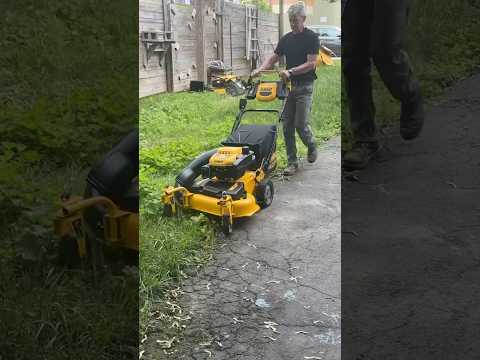
We ended up testing the DeWalt 28-inch dual blade walk-behind mower and even though it costs a small fortune–-as lawn mowers go, anyway–-it will put days back into my life over the course of a mowing season. While DeWalt’s 21-inch gas lawn mower is a fine machine–ironically the smaller machine is better when lawns get out of control–the extra 7 inches of swath really adds up fast.
Think of the mower settings and maintenance as an additive to help the fertilizer do its job and help keep your lawn healthy, green and vibrant. So good luck and hope you have success when you fertilize your spring lawn this year.