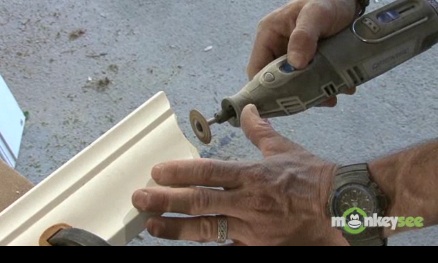
Chainsaw chains get dull and it’s important to take the time to sharpen the chain because it’s safer to use a tool when it’s sharp than when it’s dull. Here’s how to sharpen a chainsaw chain like a pro. And watch the video to help master the steps.
BTW: I brain-cramped in the video. This is a 100% eye-protection project for me. If a piece of that ceramic comes off at 35,000 RPMs, it’ll be near the speed of light by the time it gets to your face.

How do you know a chainsaw is dull?
Easy. Rather than producing chips or shavings, it spits out sawdust like you’d see produced by a miter saw or table saw.
Obviously, it’s not cutting as fast as it was when you started, but until it’s not cutting, really, at all that’s a gray area. Sharpness diminishes over time. If you don’t use a chainsaw all the time and don’t know what to look for–or how to easily it is to sharpen a chainsaw chain–you may try to continue cutting to wonder if there is a problem and/or what that problem is. I know I have.
Or, you may know what you’re dealing with and buy a new chain or chains (recommended if you’re plowing through lots of wood fiber) and/or send them in for re-sharpening, which can be an expensive, very time-consuming maze.
First step, understand that chainsaw chains have
ATB–Alternate Tooth Bevel–
meaning there are right and left teeth.
What’s in this Sharpen a Chainsaw Chain article?
- Top-Line: How To Sharpen a Chainsaw Chain
- Tools Needed
- The Sharpener (me)
- The Tool
- Safety
- Jargon and Tips
- Chainsaw chain vs chainsaw blade?
- What's the part of chainsaw that we sharpen?
- Why is a chainsaw chain look like that?
- How does the chain move through the chainsaw?
- What is that space where the chain enters a chainsaw called?
- What is the raker on a chainsaw?
- Do cordless chainsaws need oil?
- What position does a chainsaw have the most power?
- What do I use to guide through a chainsaw cut?
- Do I need to rock back and forth when I use a chainsaw?
- The Technique
Top-Line: How To Sharpen a Chainsaw Chain
Tools Needed
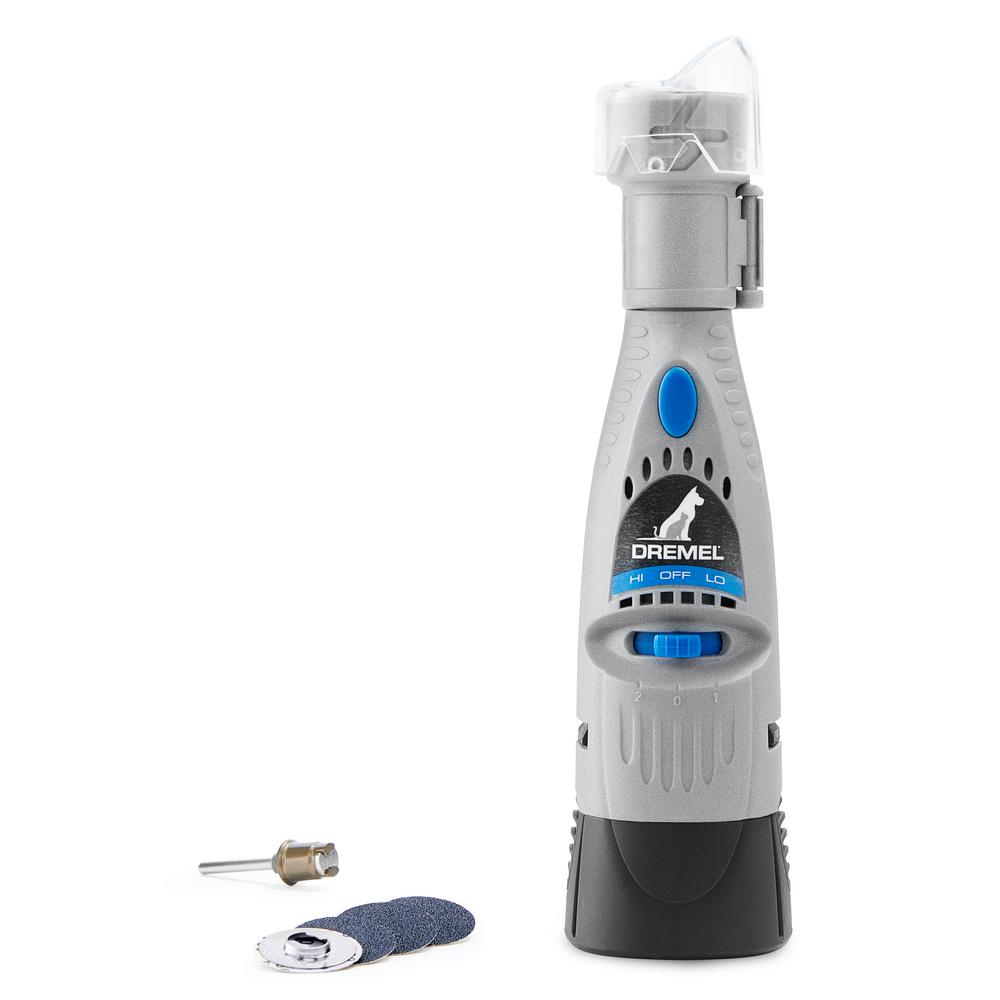
Abrasive discs for Dremel or Dremel sharpening kit
The Sharpener (me)
I’ve been running chainsaws since I was in high school on jobs I’d NEVER expose my high school-aged son to in a quadrillion years. Somehow, I made it work with chainsaws from Sears.
The guidance in the directions back then was running a circular file through each tooth–at exactly the right compound pitch–to expose new, fresh, sharp steel. It’s still the go-to for tree-service people. It’s fast, free, and–-unless you’re me–-easy.
I’ve succeeded ZERO times with this method.
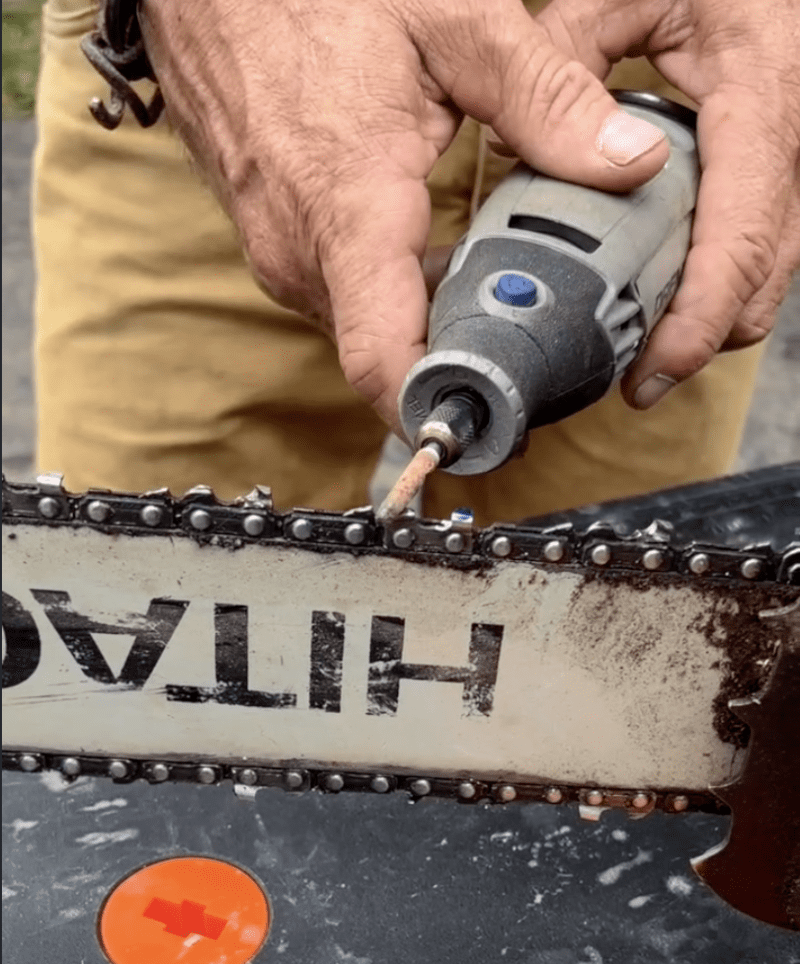
I’m not sure how I got this idea, but my Dremel tool comes with cylindrical ceramic bits–-that apparently come in a sharpening kit now; you can buy them individually at Lowes, too– whose actual purpose I don’t know. I don’t even think Dremel knows what they’re for. However, they’re perfect for the chain teeth I need to tune up.
How do I know? Shavings, not dust. Every time.
The Tool
The corded Dremel 3000 is great. I use it when there’s no other tool to use. it has come big on numerous cuts I can’t seem to recall right now, in particular, the Dremel abrasive discs have come up big. I forget where, but they have.
95% of the rest of the stuff that comes with the Dremel, I don’t know what it’s for or how to use it.
Safety
I brain-cramped in the video. This is a 100% eye-protection project for me. If a piece of that ceramic comes off at 35,000-rip ‘ems it’ll be near the speed of light by the time it gets to your face.
Jargon and Tips
Chainsaw chain vs chainsaw blade?
A chainsaw does not have a blade. A chainsaw has a chain and we sharpen the teeth on that chain.
What’s the part of chainsaw that we sharpen?
The part of the tooth we sharpen is called the gullet.
Why is a chainsaw chain look like that?
Chainsaw chain geometry is based on how a beaver’s teeth slice through would fiber.
How does the chain move through the chainsaw?
The track the chain rides in is a bar.
What is that space where the chain enters a chainsaw called?
The spikes on the saw body where the chain enters and exits the motor are called pawls.
What is the raker on a chainsaw?
The leading edge of the tooth is called a raker and I filed that because someone at Stihl told me to with their terrible hand file. I get the reasoning, but I’ve stopped filing the raker
Do cordless chainsaws need oil?
Chain saw chains–cordless or gas/oil mix (AKA 2-stroke)–require what’s called bar oil or chain lubricant. On a 2-stroke, it drains about ½ as fast as the fuel, so I fill them both when I run out of gas. On a cordless unit, I’d check the instructions. They’ve probably sized them to drain as the battery drains, but I don’t know and I’m not looking
What position does a chainsaw have the most power?
The saw has the best power and you have the best control when the wood (the “work”) is butted into the body of the saw. We cut branches sometimes with the front third of the chain to minimize bending, but if you’re hogging through firewood, I don’t recommend it.
What do I use to guide through a chainsaw cut?
Use the pawls to guide the saw through the wood.
Do I need to rock back and forth when I use a chainsaw?
If you use a chainsaw a fair amount and the paint has worn off the bar, chances are high you’re adding an additional “sawing” motion and cutting in the middle of it. You don’t have to rock back and forth. Stand still and let the saw do its thing
The Technique
First, put on your safety glasses. I’ll wait.
Ok. Let’s go. You want to match the Dremel bit diameter to the hook shape in the gullet. I use the gray and orange Dremel bits to sharpen my two chainsaw chains. The gray one is for the smaller saw with smaller chain gullets, the orange one is for the bigger Stihl. The kit has a third, larger size.
Adjust Chain
By the time a chain is dull it’s also probably a little loose, so tighten it up before sharpening. There’s “tight” and “way too tight.”
“Tight” means that when you pull the chain away from the bar, the stuff that rides in the bar–-the tooth body–-comes 90% of the way out. If you can see the bottom of the tooth body, it’s too loose by a hair.
Also, there’s some play at the tip of the bar. After you get the tension you want, hold up the tip of the bar, then tighten.
If you’ve done all this correctly, the chains should travel fairly easily. I use the chainsaw wrench instead of my hands to move the chain.
Sharpen
You can sharpen a chainsaw chain on the ground, but I prefer a table. First step, understand that chainsaws are what we call ATB–Alternate Tooth Bevel–meaning there are right and left teeth. That means you have to do ½ the teeth in one pass, ½ in the other after flipping the saw around. Before that, however, you need to know where you are on the chain. Mark a tooth with a Sharpie.
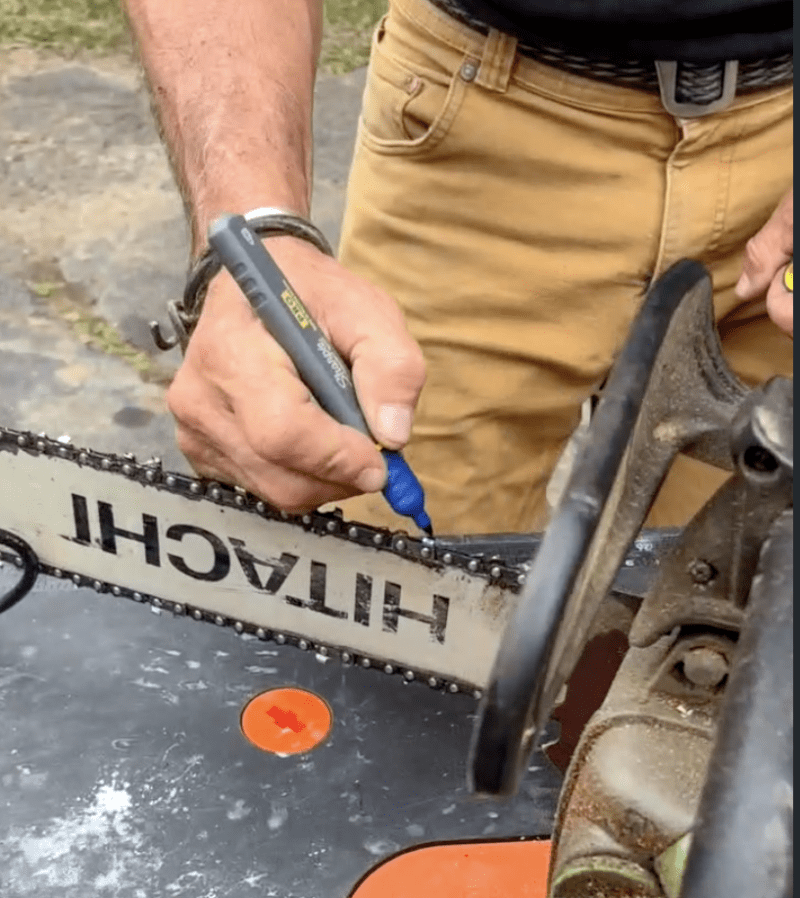
Now you have to get under the hood of chain geometry. It’s not rocket surgery, but it is a compound angle. If you go in there and change that geometry, you’re defeating the purpose.
So, match up the bit with how the gullet is shaped and get a feel for how that feels and what it looks like on both sides of the saw. It’ll take you longer to read this than to do it in real life.
Once you’re oriented in space and know what the tool feels like, let’s go. You can see in the chainsaw sharpening video it doesn’t take long to expose sharpness.