The PowerLoad 16-inch eGo string trimmer is a sneakily annoying, underperforming tool wrapped up in a unit with outstanding design cues. And it works!
The Tool
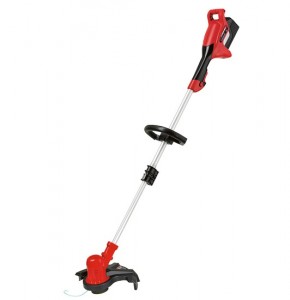
The eGo Power+ 16″ PowerLoad String Trimmer with Telescopic Carbon Fiber Shaft Model #ST1610T ships with one 56-volt 2.5-amp-hour 56-volt battery and charger. The maker claims it has up to a 45-minute runtime, IPX4 weather resistance, and a 16-inch cutting swath. “PowerLoad” is a feature that uses energy from the battery to wind new string onto the cassette.
Summary Tool Review
There’s more detail below as to how I arrived at this conclusion, but here’s the punchline: This was about the most vexing tool review I’ve done. Why?
Because the eGo PowerLoad 16-inch swath string trimmer is a sneakily annoying, underperforming tool wrapped up in a unit with outstanding design cues. And it works!
That’s what got me. It does work. And if you haven’t used a zillion other string trimmers like I have, it might just work fine for you.
I had a top-notch review already written, too. It included power, balance, battery, runtime, and even the dubious PowerLoad feature. All worked.
But there was something else I couldn’t quite put my finger on that was hiding in plain sight. I had let the lawn go a few weeks and it was the night before we left for vacation. Put to the test of being in a hurry, I couldn’t ignore the design quirks any more.
Also, if you’re looking to expand your eGo line with a string trimmer, there is a definite solution in here. eGo has a commercial line of tools.
OK, on with the details.
Top Line Observations
The eGo Power+ 16″ PowerLoad String Trimmer with Telescopic Carbon Fiber Shaft is designed for homeowners to use on regularly maintained lawns. If the PowerLoad works just 1% better than the giga-DIY gas unit I have now, I’ll throw a block party. It does.
- The tool set up in minutes
- The string spins clock-wise, not counter clock-wise. This is atypical
- Light, well balanced design
- Outstanding fit and finish
- The bump feed works extremely well on hard surface and in the grass
- IT’S GLORIOUSLY QUIET!
- Awesome power
- No gas, oil mix, spark plugs, pump priming
The Test
Here’s what we’re evaluating when we test a string trimmer:
- Out of the box. Fit and finish. Balance. Feel
- Torture Test: Untamed lawn trimming, Boston ivy, lawn edging
- General whacking of weeds
- Spin direction
- The guard/string cutter
- Material ejection
- Runtime (sorta, we’re not a lab)
- “Hot spots”
The Reviewer
MyFixitUpLife provides general home remodeling services. On our upper end we do 6-figure projects. We also do property management, snow management, and repairs. Many of the decks we build have landscaping requirements, so we’re never far from mowers and blowers and lawn interventions. And, until recently, I had a lawn route. I have used and reviewed cordless outdoor power equipment while doing it.
“Mow and Blow Guys” and The Case for Cordless
When I came up mowing grass, we pushed the mowers. Many homeowners–or their teenagers–mowed their lawns. Some mowed on Monday evening, others, just before the weekend or a party. That was then.
Now, lawn mowing (and hedge trimming and whatever else) has been industrialized. I call it the Mow and Blow model. In the suburbs where I build all our decks for our customers to be, ostensibly, comfortable outdoors, you need to schedule around the shi+ storm of all-day-zero-turn-mower-blower all day cacophony. It’s all audible from 400 yards away and it disturbs your home office, your baby napping, and a pleasant day off.
To that end, as expensive and problematic as batteries can be, I think we all want rechargeable batteries to be our future in yard care.
The Review
We did with this tool what we do with all the tools we review. We wove into our work flow.
We’re not a lab.
Neither are the other reviewers who have eLABorate “tests.”
Sure, these structured tests might show some things. But, they miss others. It’s mostly theater. I don’t care how the tool works with a weight hanging off it. I care if I’m constantly changing batteries or I can’t see the cut line or if it feels like it’ll fall apart next week.
Out Of The Box
Set up was straightforward and easy. The fit and finish is outstanding. The battery exchange is excellent. We’re also testing the eGo PST1400 Power Station, so I used that as the charger and it is well-designed. The tool is well balanced. The guard is wider than other units I’ve reviewed. This ended up being a bigger issue than I thought, one that has what I think is an easy solution.

Typical Use
This unit’s design–-not uncommon in some professional outdoor power equipment we’ve tested–-is optimized for lawns that get mowed regularly. Yes, we torture tested it, but we did so with this in mind.
Torture Test
Our town does a No Mow May to support pollinators. Awesome. I’ve been doing No Mow May for years as I transition from the brain damage that is snow removal to trying to max out my grass for tool reviews. It’s a lot.
We jacked up the grass and had it with the eGo string trimmer.
It was a little bumpy but the unit smashed grass clusters (they’re more dense at the bottom than the top) pretty darn well. I compared it to my gas unit and the gas unit had a little more umph, but not much. I also didn’t have to do the gas unit dance: Specific gas can, mix-oil, trip to gas station, tune-ups.
Battery Life
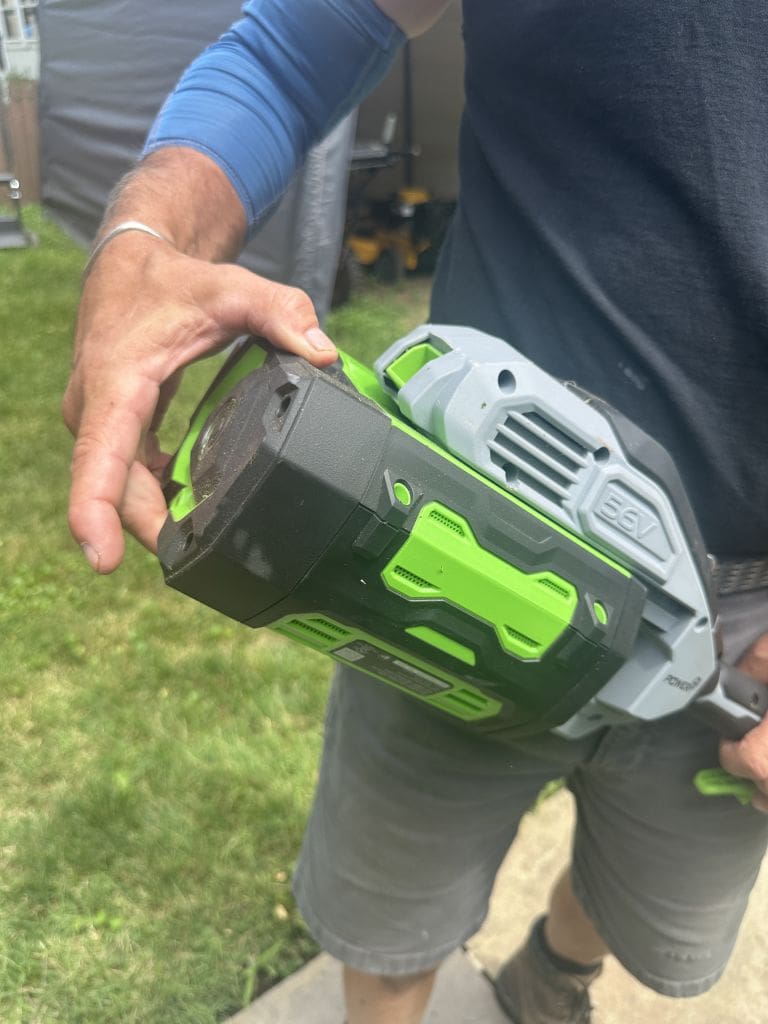
I’m no more of a lab than anybody else who is counting numbers of cuts. What I can report, however, is that I did at least 15 minutes of torture testing, 30 mins of high-grass trimming and edging. The battery was there.
Durability
I’m basing my assessment not on time in the field, but on two other elements. I’ve run other eGo units before and this appears as robust as they are and with other–-much more expensive units–-I feel no heat (hot spots) from the battery getting through to me while I use the tool. This thing hums.
Spin Direction
This is a thing for me. It’s not the end of the world, but I have to make some serious adjustments to how I work so this can work. Yes, the unit delivers power and is well-designed, but it spins clockwise. The reason for this is the PowerLoad system, which spins counterclockwise.
I watched a video where the guy says that all he does now is walk backwards and it works fine. Walk backwards? Are you serious? OK, maybe, but I think he just wants more tools sent to him. In the end, this is a design-miss for me.
That said, I tried it. I tried changing the direction I walk yards and that sort of work, but it didn’t really work. Add that the string is 1 inch shorter than I typically use and suddenly there’s a lot to think about. Again, that’s a miss.
Most units spin counter clockwise. This means the trigger is in your right hand, the handle is in your left. You approach the work from right-to-left and as the string cuts, it ejects material to the left and away from what’s next. And you walk forward.
If the unit spins clockwise it drives cut material into uncut material. Sure–-and it is pointed out in the instructions that I’m the only person who has read–-that you just need to change directions. With all the nooks and crannies in a yard, this is easier said than done.
Edging and Scything
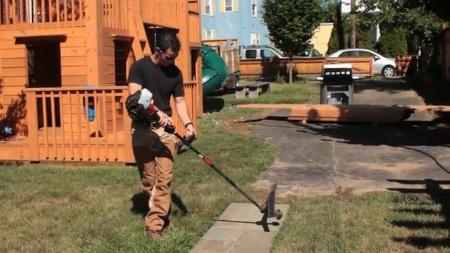
Easily most of the time I’m using a string trimmer, I’m using it as an edger, so the string is vertical and I’m cutting along a walk or driveway.
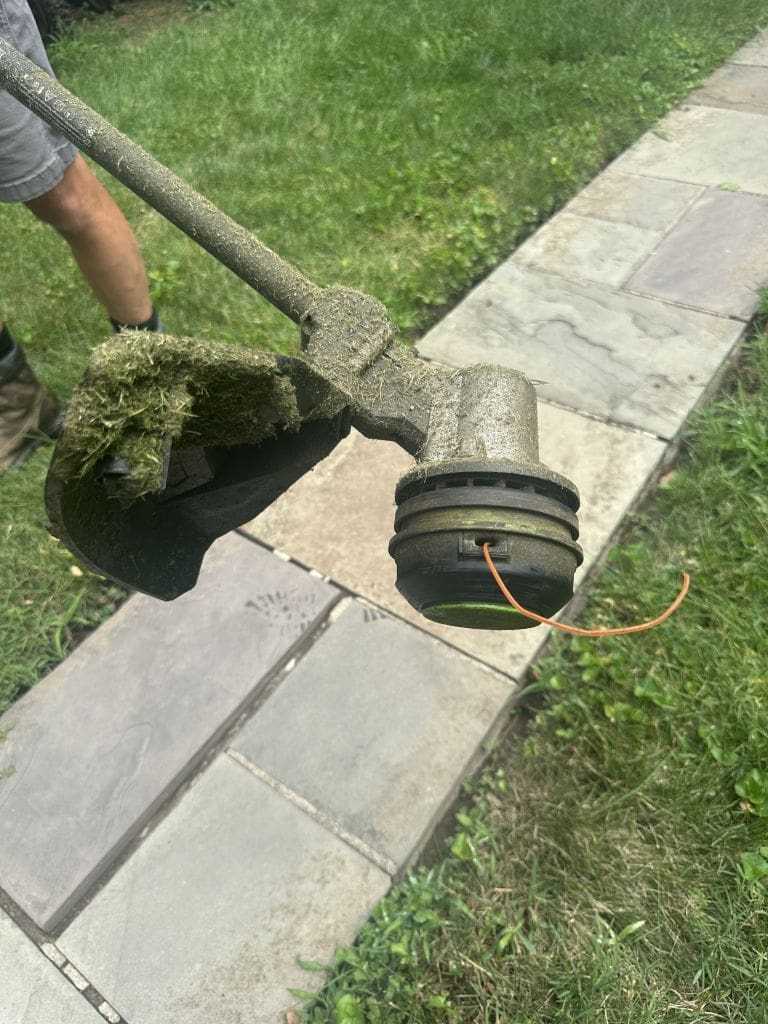
On an overgrown yard that really needs some intervention I use the unit in a “scything” motion to knock tall grass down in lifts. And here we find another issue with the unit–-the wide guard.
Sure, it’s wide and ostensibly safer and I’m sure there’s an eGo actuarial calculation, but to me it is a giant pain in my butt.
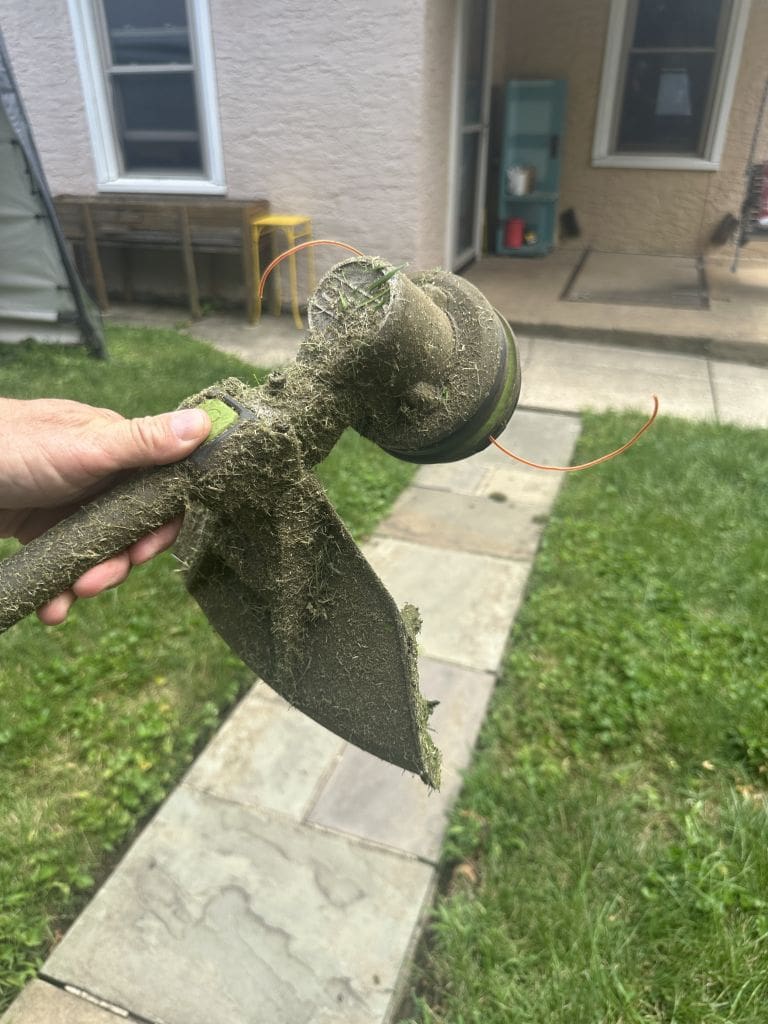
Edging, you can’t see past it. There was just no configuration I could figure out where I could do the work I count on a string trimmer to do. Scything, there’s so much guard it doesn’t take much resistance–-which is impossible not to encounter–-to snag it, tip the unit and either knock you off course or plunge the tool to the turf and scalp it.
This was the straw that broke the camel’s back by the way. Using it–-in a hurry–-on my overgrown but not crazy lawn and it just get snagging and plunging. AND I’m walking backwards? That’s too much.
Angle Cutting
Lots of lawn trimming requires getting the string under a fence or around a pool edging or other barrier. It works, but there is the calculus of spin direction and approach.
With this unit, between the guard, the spin direction and the shorter than normal string length I use, I found trimming under obstacles spotty at best.
PowerLoad
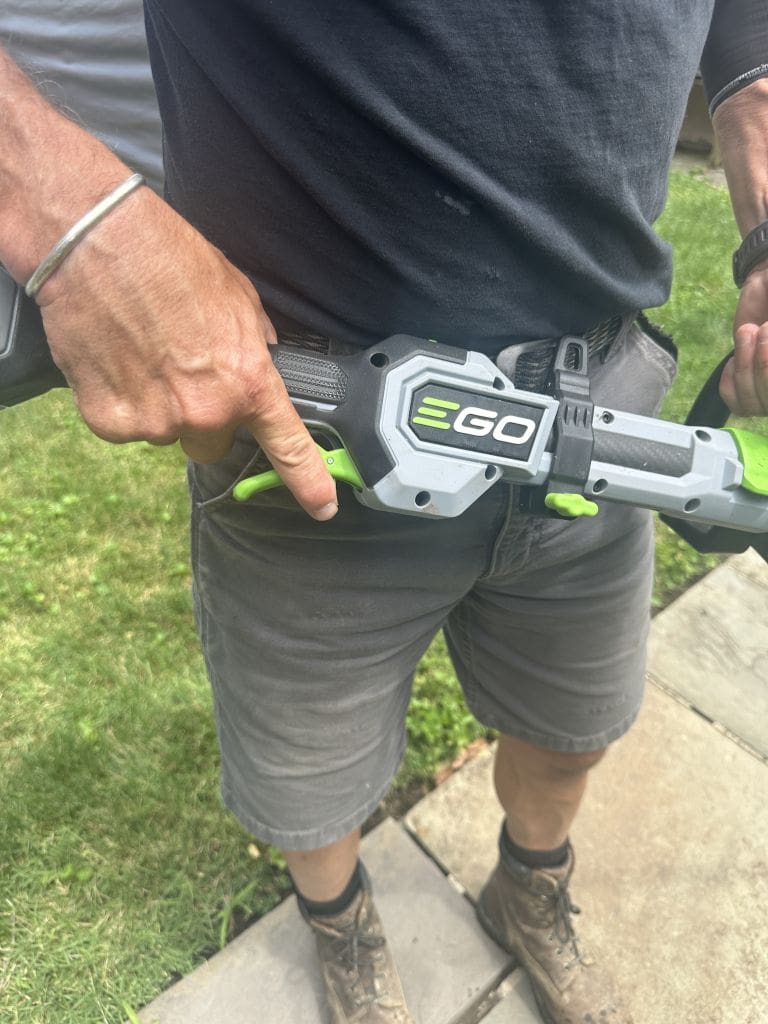
It took a little getting used to, but this “auto” string loader is the best I’ve seen of the solutions for winding string (which, by the way, isn’t that hard on an old school unit).
The Good News
For not that much more money–-which a far slimmer guard and a cassette that is impossible to believe doesn’t spin counter clockwise–-and a 17-inch swath, I’d 100% call that unit a safe bet for outstanding performance, easy string winding, and battery tech that’s both powerful and dependable–with no design trade-offs.
Test Results: Bona Fides
- Tech, materials, price point are all fine on the eGo Power+ 16″ PowerLoad String Trimmer with Telescopic Carbon Fiber Shaft Model #ST1610T
- The pro string trimmer from eGo, assuming a counterclockwise spin, might be a better investment
Editor’s Choice
- Needs improvement in key areas