There are common methods for building a deck and there are common myths that many believe are true because they read it online or a buddy told them. We’ve been building backyard decks for decades and have the pleasure of reading comments on our deck building videos. Some comments are hilarious, occasionally they are helpful, and often they are misguided. So here’s 7 wood deck building myths debunked by a professional deck builder.
So why are we addressing wood deck building myths?
Hi, It’s me. I’m back from the Comments Section. While wading through there, I do my best to address real questions, observations, and issues from viewers. While I know a lot about building decks, specifically wood decks, I don’t presume to know everything. There are many who claim to know it all, but I don’t count myself among them.
I’ve also learned—and I don’t know if this is specific to the carpentry/remodeling/DIY wing of the home improvement party—that the vast majority of comments we get are because I’m not necessarily doing something wrong. Rather, it’s “wrong” because it wasn’t how the commenter was taught to do it.
And that’s it. Reasons? What are reasons?
Our video How To Rip A Long Board On A Table Saw By Yourself is a good example. People get irate and claim that I’m 100 percent going to be sucked into the table saw. OK, I get the claim, but that’s just not how table saws work. It’s not my fault that I know this, but they lay blame at my feet anyway. (And, no, we don’t suggest that a newbie try to rip a long board on a table saw. Start with something easier to manage until you really know your table saw and skills.)
The toughest group is the fake experts. Maybe they watched a bunch of videos or worked a summer or two doing some kind of remodeling, but it’s obvious that most of their information is what they were told or saw online, not what is real.

Wood Deck Building Myths 1: You Have to Gap Deck Boards
There are a few exceptions, but unless your deck boards are a Special Order the answer is No.
Why Not Gap Deck Boards?
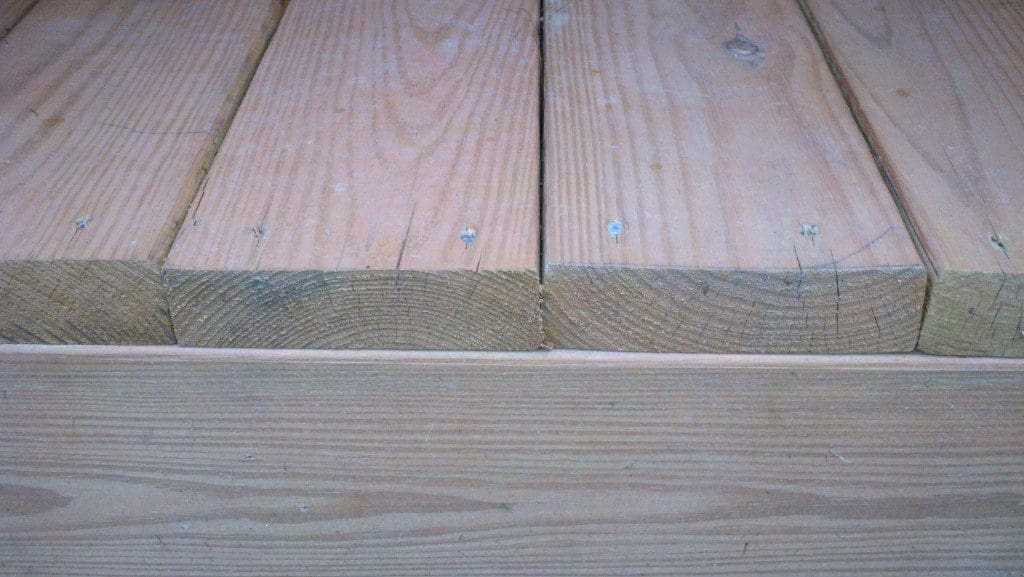
The reason you don’t need to gap deck boards is simple: They’re saturated when they slide off the lumber truck. Moisture content can be as high as 40 percent. (I’ve seen some claims it’s higher, but the owner of my lumberyard tested his stock with a moisture meter; I’ll take his data over any blowhard any day.)
Why the moisture content is so high is by design. It is a miracle of the supply chain.
Milled Southern Pine boards enter pressure cookers I’m told are 100 yards long. The chemical that makes them inhospitable to the microbes that eat wood fiber is waterborne. As the lumber absorbs the chemical and the water it’s in, it expands.
The chemical bonds to the wood fiber at a molecular level (not so for other species like Douglas Fir, for example). As the water leaves the deck board through evaporation, the deck board stabilizes to its intended/finished size–5 ½-inches.
Millions of board-feet leave mills every day (1.8 BILLION in February 2026 alone). They all sit in bunks in lumberyards until they’re needed, then they land on your jobsite. Unless you’ve ordered KDAT (Kiln Dried After Treatment) there are no “dry” boards in the supply chain. You can test them with a moisture meter if you want, but rest assured, they’re wet and will shrink.
If you gap them, add about 3/16-inch to whatever your gapper is.
What About Pine Needles and Leaves?
What about them? The deck cladding isn’t a sewer grate. It’s both functional and cosmetic. Moreover, leaves and twigs and needles are still going to get jammed in between boards gapped wider. Get a blower in there and clear out accumulating debris.

Deck Building Myths 2: Miters Stay Closed
One of the reasons I like decks is that they’re sort of a nexus between rough and finish carpentry, both of which I enjoy.
However, see above. We’re working with soaking wet lumber so there are some adjustments I make to keep the details tight. On a wood deck, this is almost entirely focused on the guardrail top cap. On a composite deck, miters show up in picture framing, stair wraps, and guard rail caps.
Wood Deck Guard Rail Top Cap
A top cap on a wood deck should be a 2×6. That 2×6 is as wet as any deck board. It is as inevitable as gravity that it’s going to change shape as it dries. At the miter, where the rail changes direction, most deck builders I interact with claim that it “looks great” when they miter it.
And it does look great. That day.
Three weeks later, bubkus. The “heel” retreats. The “toe” advances.
I also get a lot of comments claiming biscuits or glue or screws or whatever nonsense keeps their miters closed.
I don’t buy it.
MyFixitUpLife’s Stepped Miter
To confound shape-shifting wood, I do what I call a “stepped miter.” It’s basically a series of butt joints and the thing stays closed.
I’ve also done a “radius miter” that the internet can’t believe is real, but is entirely true and our clients like it.
Composite Miters
I’m not giving you any secrets about how composite behaves. It’s in the instructions you don’t think you need to read, but it does behave. If the instructions don’t come with your lumber order, ask for them or read them online.
- Can you miter composite without the same risks as PT? Yes.
- Are there other issues with mitering composite? Yes. They’re based on temperature. In a nutshell, if installing it in August, keep the miters tight. January? 1/8-inch gap is necessary so the material can move.

Wood Deck Building Myths 3: Wood Decking – Grain Up to Cup?
Not just No. Hell, No.
Maybe years ago when the transition from hand-drive double hot-dipped galvanized nails and/or twist shank nails gave way to “electro-galve gun nails” there was a case to be made. Maybe.
But in the world of top-drive screws, pick the best face and screw it in.
Diving deeper, the myth isn’t really about the grain orientation—smile up or smile down—it’s about uneven drying and several other inputs, as I said above.
I can count the callbacks for cupped decking on the decks I’ve built on, well, I can’t count them. I also don’t see it in the wild either.
Wood Deck Building Myths 4: Kiln Dried After Treatment: Decking – Staining
Kiln Dried After Treatment pressure treated lumber (KDAT) is just as it says. It’s been dried. Somewhat.
Kiln drying makes material more difficult to source (at least for me; I’d have to buy an entire bunk for my lumberyard to order it in). It’s for sure lighter. There are other trade-offs.
Can KDAT Be Stained Right Away?
You can try, but I wouldn’t. The word “dried” is doing some heavy lifting here. Yes, it’s “dried” but it’s not “dry”. At about 20 percent moisture content, I’m not touching it with a coating until it’s closer to 10 percent. It won’t take as long as typical PT to acclimatize, but it can’t hurt to wait.
Is KDAT Good For Decking Because It’s Dry?
I guess. Again, trade-offs.
First, you have to source material with the correct rating, aka chemical retention level. While I’ve never seen a typical PT board that’s NOT rated for ground contact—and also works just fine for decking—I’ve seen KDATs rated AG, Above Ground.
And, in theory, this is fine. However, I’ve pulled up enough old decks to know that what wasn’t “ground” when it got trapped between the deck boards–especially on top of the joist—leaves, twigs, seed pods BECOMES ground after a year of sitting there decomposing.
Wood Deck Building Myths 5: Plastic Post Sleeves Will Trap Water and Rot Deck Posts
We use a $35 plastic post sleeve called Post-Protector instead of 8 million bags of concrete, tubes and expensive brackets.
How To Set A Deck Post Using Post-Protectors video annoys the fake building-science people to no end! While we could talk about it for an hour, I’ll leave you with 4 things, then get to debunking.
- They build buildings with Post-Protectors. Code-approved.
- Not a single plan reviewer has “red-lined” Post-Protectors across various jurisdictions on my decks.
- While lots of this information applies universally, our focus is the Eastern United States where we build decks with pressure treated Southern Pine.
- Your mileage may vary.

Why Post Protectors?
We brought it over from the Pole Barn industry (check out our mini pole-barn build here) and it works wonders for us building decks. As with pole barns, our deck plans get approved all the time across multiple jurisdictions.
There’s a bunch of building science as to why the hair-on-fire claim that “water will rot your posts” doesn’t hold water. 1, 2 skip a few 99, 100:
- Water ALONE does not decay wood fiber.
- Water + microbes + the right temperature + oxygen + a food source causes wood decay. This only happens at or near “grade.”
- Remove one, you remove them all.
- The chemicals in PT are designed to be unappetizing to the microbes, but it doesn’t last forever. It’s still a tree after all.
- The reasoning behind tubes and concrete and brackets is to isolate the post from ground contact. Period.
- Post-Protector does the same thing while eliminating a hundred expensive, super labor-intensive steps. There are also provisions for both drainage and evaporation. You can even buy a Post-Protector Cap.
Wood Deck Building Myths 6: Notching Guard Rail Posts
I’ll be honest, setting guard rail posts is my least favorite part of the job. I work alone a lot and it is the biggest wrestling match of the entire enterprise. So, when I’m tearing down an old deck with guard posts notched over the decking, I get jealous.
It’s elegant and cool, but it ain’t right.
- Notching a 4×4 essentially turns it into a 2×4. Yeah, a lot still has to go wrong for this to fail, but if that lot goes wrong, it’s not good
- The end grain sitting on the decking wicks up water and organics in it, a wood decay catalyst.
Surface mount deck guard posts or box-build deck guard posts inside the deck’s band joists.

Wood Deck Building Myths 7: You Have To Build A Deck From The Ground Up
I’ve seen various media on deck building using all kinds of strings and batter boards and other Rube Goldberg hoo ha to lay out where a deck is going to inhabit space in real life.
If that works for you, great. My approach—I didn’t invent this, but I did refine the hell out of it-–is to use the deck itself to establish layout.
Top-Down Deck Framing.
Unlike platform framing (how most homes are built) where there’s a foundation and structure UNDER what you’re going to build, a deck is in the air. How do we figure out where to put stuff?
We can’t measure from the ground because it slopes and is lumpy. We can’t measure from the sides of the house because they’re too far away.
The best way I’ve found to do it is to use the only real “known” we have—the house—and go from there.
There are lots of ways to build decks, but for the most part, they’re centered off the back door.
- The center of the back door is the center of the deck. Boom. We now know Left and Right. If your deck is 16-feet wide, it ends 8-feet to the L/R of this point MINUS 1 ½-inches on each side. We’ll get back to this.
- The back door threshold should be level. Sometimes they’re a hair off. Pick the low side. Now we have a control point for level.
- The rest is in our Top Down Deck Framing Video series.

What wood deck building myths have we missed?