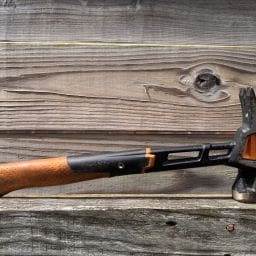
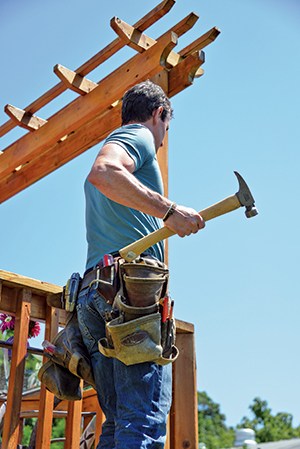
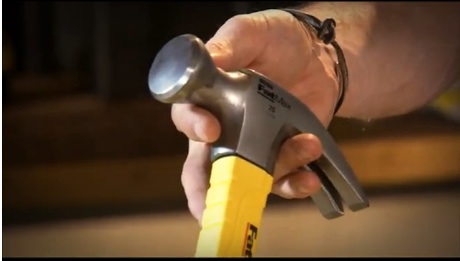
These days I carry Estwing’s 19-ounce Ultra Series Smooth Face Rip Claw Hammer with Leather Grip. It is my every-day carry. And this Estwing hammer is awesome.
My Hammer Origin Story
I got my official start in the trades working for a framing subcontractor as a helper. I weighed maybe 100 pounds and rode my bike to work. To be fair to me, it was 5 to 8 miles, not nothing. I ran track and cross-country in high school and I while I was fascinated with how rugged these guys’ lives were, I was about as strong as herbal tea.
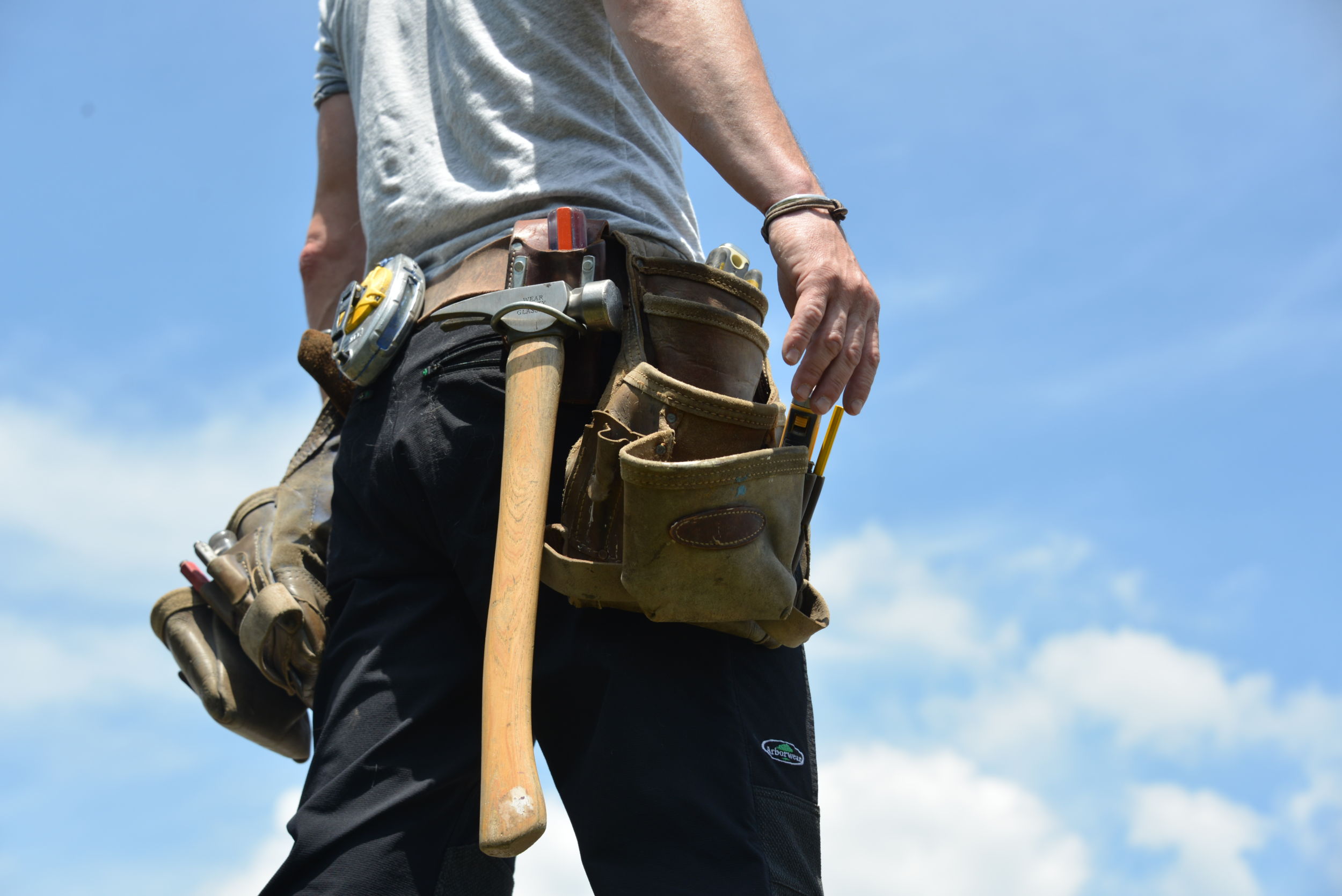
They ran Porter-Cable sidewinder circular saws, wore leather nail aprons and leather Converse All-Star basketball sneakers. Their hammers were blue-handled Estwing E-22s. Basically, clubs for a guy like me.
As the years went by (and I got through, like, an 8-year puberty) and I got into decks and remodeling, I settled on Estwing’s E-20. A general purpose hammer I used while hand nailing all the docks and swim floats I built working a stint in marine construction on Cape Cod.
The only way to damage these hammers is to lose them.
The only way to damage these hammers is to lose them. That’s fine, but they have some fatal flaws for modern remodeling and general purpose work: The claw isn’t designed for how we use hammers today. It’s only designed to pull nails, not to get behind trim or use as a lever. Also, the blue handles are for framing. They work, but they’re not awesome.
I’m happy to say Estwing didn’t get stuck in my past. These days I now carry Estwing’s 19-ounce Ultra Series Smooth Face Rip Claw Hammer with Leather Grip. It is my every-day carry. And it’s awesome.
Topline Observations of the Estwing 19-ounce hammer
- “Alloy” steel construction has this tool punching above its weight.
- Steel, as compared to lighter materials, means I don’t have to Thor something to move it. On the other hand, if I do need to Thor something, I have the hammer.
- 19 ounces is comfortable in the belt.
- OUTSTANDING rip claw geometry.
- The old-timer in me somehow subjectively loves the leather handle. It’s lacquered in the factory which makes the first six months of using it like driving nails with an eel, but it breaks in.
- The handle flare works.
- I’ve dug dirt with this hammer. Not my proudest moments.
Review Summary
Estwing’s 19-ounce Ultra Series Smooth Face Rip Claw hammer with leather grip wouldn’t be on my hip if it didn’t deliver across the wide variety of work we do. It acts as a lever, wedge, and “persuader” in the same gesture. I’ve even used it to gouge dirt out of shallow holes so I can fit items like hardware fabric or the corner of a 6×6. Like the Estwing hammers before it, the only way to kill it is to lose it.
The Test
I’ve had this Estwing hammer for years. I have other hammers. I can get new hammers. I’ve had new hammers sent to me. This is the one that stays with me through decks, demo, fences, kitchen renos and the million 1-of-1 projects most typical remodelers either sub out or decline, aka eschew (bless you!) for the “kitchens-baths-basements” model.
The Tester
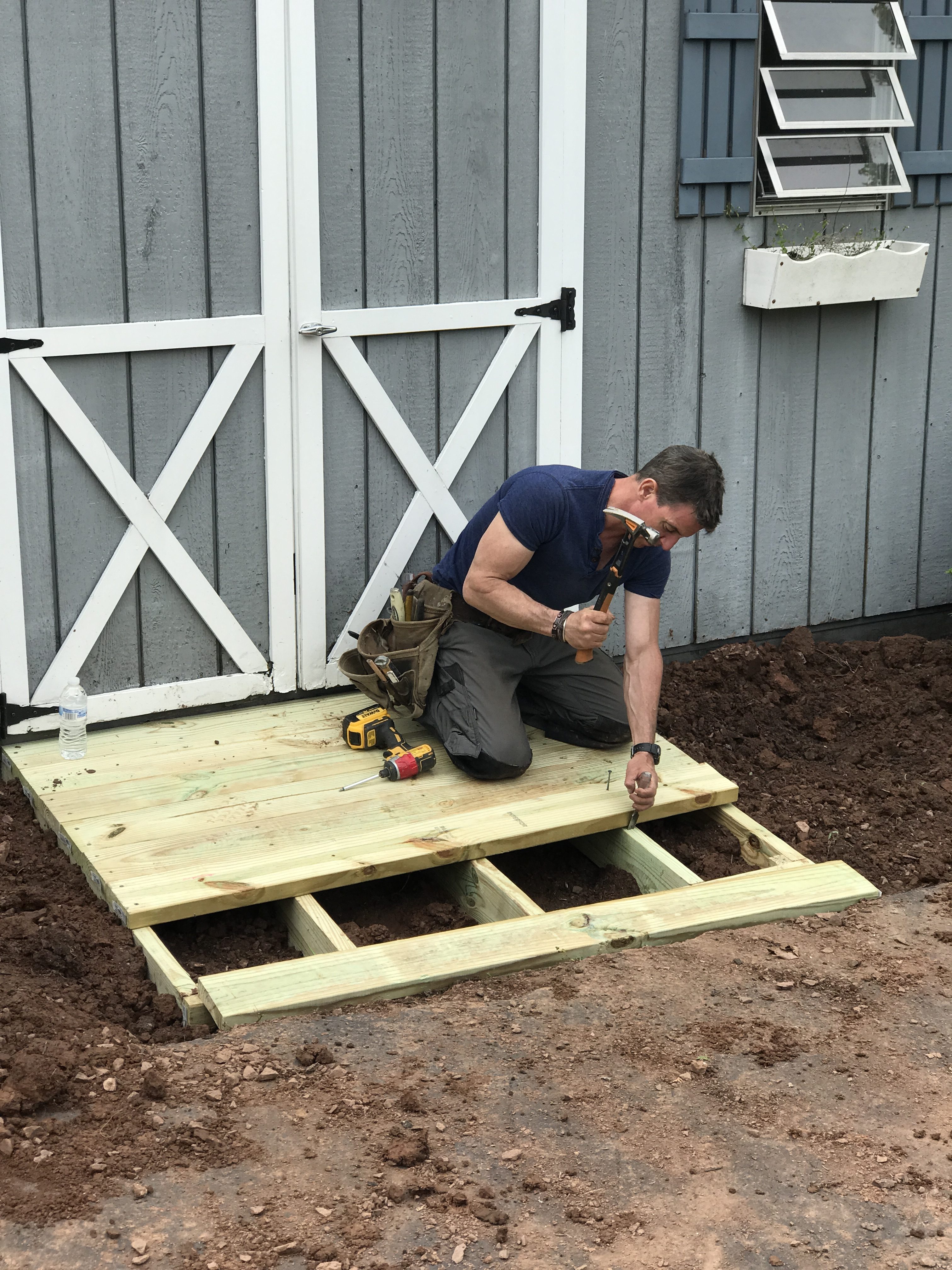
We’re full-service remodelers and deck builders with tendrils into fence building, pergolas, kitchens, basements and more. As such, we really don’t drive nails very often. Our hammer use is mainly as a “persuader” or on-board lever we use to nudge everything from a bottom plate to the chalkline, to our “chisel trick” I learned building swim floats (think wood deck that floats in the water) a couple three lifetimes ago, to splitting 2x4s around hot wires on demo projects.
We also serve realtor clients in a pre-sale capacity–-fix this, trash that–-and post-sale capacity as a referred vendor where it could be anything from taking down an old fence to rebuilding a 25-year-old paver patio surround.
The Results
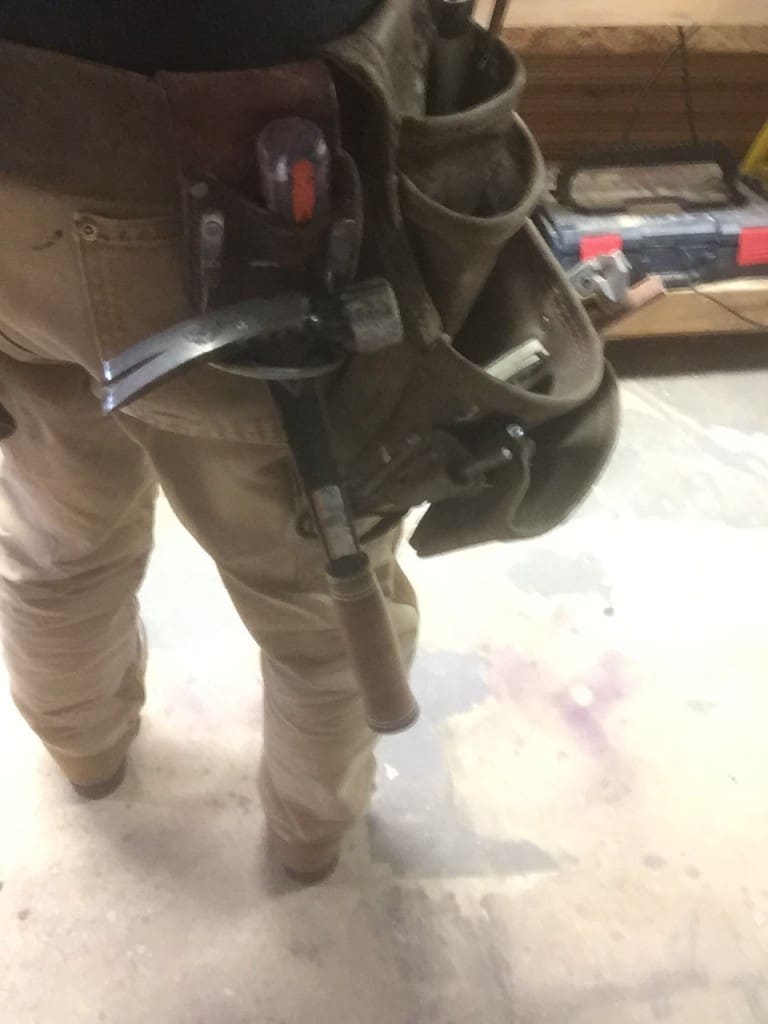
For a tool ostensibly designed to drive and pull nails, the Estwing hammer works for all the other stuff I throw at it extremely well.
Feel
The 19-ounces of alloy steel, handle geometry and length totally work for me. The corollary is that if all I did was frame, it’d maybe be too short. If all I did was trim and millwork, probably too long.
However, I do all those things and more and this tool is sweet-spotted.
Balance is excellent, I can generate suitable power when I need it to, say, straighten a fence post
The leather handle’s factory-applied lacquer finish does eventually break in, but it took about 6 months before it wasn’t slippery. Now, it’s almost like an extension of my hand.
The Head
The head is right-sized for the wide variety of the work we do. If I need to beat on something the head is big enough that it doesn’t just smash the wood fiber into a dimple. And it’s small enough–-not so with the equally weighted Space Shuttle material hammers–-to drive little finish nails from time to time.
Rip Claw Fetch
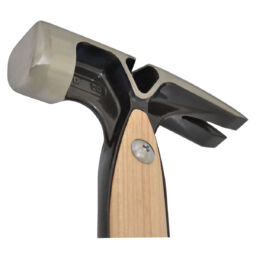
Fetch refers to the curvature of the hammer’s claw. The more shallow the fetch, the more useful the hammer is–it can’t be zero–the better. Estwing nailed this with a very shallow fetch that enables me to get the hammer claws behind and under things. Further, their alloy enables it to be more slender than other hammers I’ve used and this is a huge asset.
40 years ago, a hammer’s primary job was to drive nails. Pneumatics and cordless technology (how much do I love my Skil 20-volt PwR Core Impact Driver) have supplanted hand-drive nails in all but a few pockets of the industry.
The teeth are both sharp enough and sharpenable.
Cost vs Value
I don’t recall if Estwing sent this to us or I just bought it. But at about $55 I win the Cost vs. Value debate all day for the work we do.
Note: I’ve had a titanium hammer and I liked it well enough, but today it just sits in a bin in case I need an extra hammer. I also get that there is a slice of the industry that benefits (I guess; I’m skeptical to be honest) from a $325 hammer made from Captain America’s shield. I think there is a lot of “I have one, too!-ism” wrapped up in this. Like Yeti coolers.
Whatever.
MyFixitUpLife Editors’ Choice?
- 100% for the 19-ounce Estwing hammer