If you are looking for the best sliding compound miter saw for DIY projects, you’ve landed in the right spot. There’s no need to spend any extra on another ‘pro’ brand because this Skil 10″ miter saw delivers. We’ve used it building decks, installing wood planks for a feature wall, and other projects in our remodeling business and at our home. The Skil 10-inch dual bevel sliding compound miter saw is light, mobile, accurate, powerful with a nice 40-tooth blade happy-blasting repetitive cuts for framing and dialing in sliver cuts to make a trim piece fit just right.

Top-Line Observations
Pros
- Positioned as a DIY tool
- Delivered professional results with some DIY quirks
- Lightweight
- Plenty of power
- Good cut capacity
- High-quality blade
- Line of sight to the work
- Smooth trigger and adjustment interface
- Plush take-off
- Great price
Cons
- Un-excellent dust bag
- Deck height isn’t 3½-inches, so making in-feed/out-feed support is trickier
The Tool

The Test
We tested the Skil 10-inch dual bevel sliding compound miter saw in general remodeling applications cutting trim, framing, and composite materials in rough and finish carpentry applications.
We then looked for ease of adjustment, fit and finish, trigger and handle interface, power, dust management and how easy (or not) it is to move around the saw. And we checked out-of-the box accuracy.
The Torture Test.
When testing a saw to find out if it’s the best sliding compound miter saw, it takes a lot of time and effort. We might do a few box-opening reviews to show how to set up a tool, but to find out if it’s worth your hard-earned cash, we have to get it out on a lot of jobs.
Most rough carpenters we’re familiar with don’t use miter saws to cut framing or blocking. But we do. It’s 1,000-times easier and faster than cutting off the stack. We put the Skil to the test on a massive deck project that required tons of blocking, 4×4 guard posts and breaking down treated stock for a remodeling project. So we gave this thing a work out.
Preconceived Observations.
While I’m set up on a trim job now with the unit, we didn’t test this tool forever like we usually do. However, several Skil tools we have tested have become our daily carries and have years in the field and there’s something to be said for brand build-quality.
- The Skil table saw, for our work, is best in class–by far
- The Skil PwrCore 20-volt impact driver is also best in class. Maybe not by far, but right there. I like it better than the pro-positioned Flex
- The Skil oscillating tool may not be best in class, but it works for me every time I use the thing
- The Skil recip saw is my back-up and it never slows down
The Tester
We’re a full-service remodeling-home improvement company. If it’s in, on, or near your house we fix it, improve it, un-do-and-re-do it. We do all the design, demo, project management and carpentry ourselves. We’re not big. But we really care about thetools we use.
The Results
After blasting pounds of sawdust through the dust chute and whipping it back and forth for trim cuts, here’s what we think about the Skil 10″ miter saw. (And why it tips the scales at being the best sliding compound miter saw for DIYers.)
“The question I want answered is: Does the tool cut what I need it to—the way I want to cut it?”
Fit and Finish.
The Skil 10″ miter saw is accurate out of the box. At about 40 pounds, it’s light and easy to get on and off the truck. The trigger interface is easy. It plunges well. There’s no “jump” engaging or disengaging the D-handle trigger. Plush motor and smooth take-off when spinning up the blade–not what I’ve seen in other DIY tools.
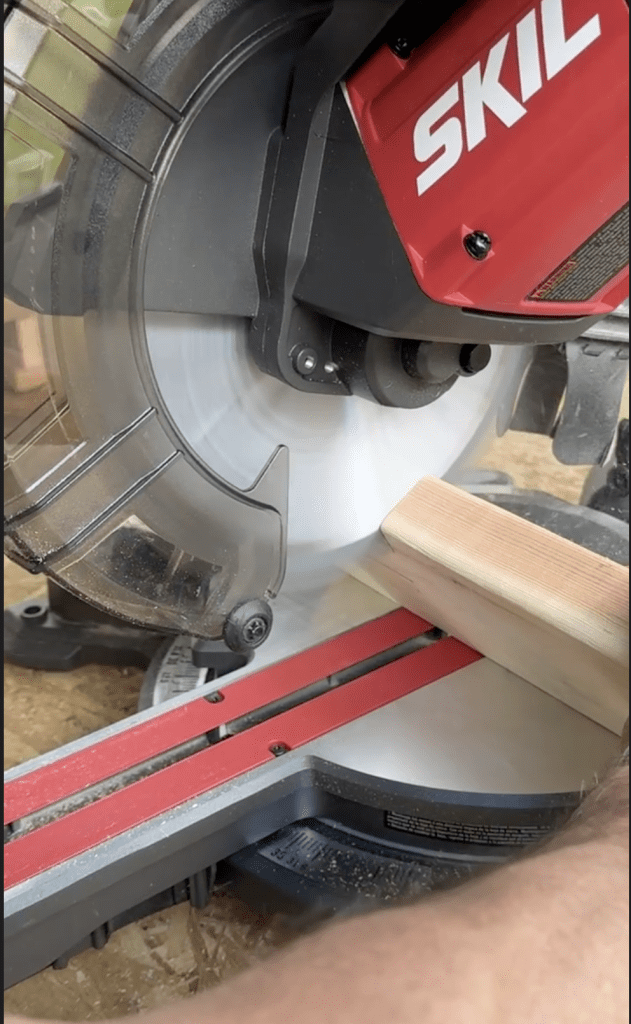
Lines of sight from both sides of the blade are excellent. We stress-tested the included blade blasting tons of PT framing on a deck project and framing for a remodeling situation. I’d expect a tool positioned for DIY to NOT deliver on plowing through 2-by while also leaving a clean cut in composite to last, but this has. The carbide is green from the treated. I have pictures to prove it.
The saw’s deck is–I’ve seen this before but it’s uncommon–not the typical 3 ½-inch height, it’s 3 ¾-inches. Why is this important?
Nice, tall fence.
Infeed and Outfeed Support.
We’re anti fans of those folding sawhorse type saw stands. I could go on for two hours as to why but the punchline is that we make our own infeed/outfeed support for the miter saw (Watch: How to make a miter saw bench).
And, we make them to support 3 ½-inch tools. Could I make one for the Skil 10″ miter saw? Sure. Can you make one for the Skil if you’re buying it for your shop? Sure. Can you set up a quick work station with 2x stock? Not really. Is this the end of the world? No, but worth a thought or two.

Adjustments.
When a poorly made miter saw fights you on every bevel or reach for a release, it’s a chafe. The more I have to fight through it or find an adjustment the more likely I’m going to yell at a piece of wood after I cut it wrong. The Skil’s adjustments are smooth, detents solid, the lock knob (I don’t know the last time I ever actually locked a knob)is right-sized. It doesn’t hook my tool belt buckle as I move around the saw.
Cut Capacity.
I’m not really a big reader of or believer in specs. The question I want answered is: Does the tool cut what I need it to–the way I want to cut it?
The answer for the Skil 10″ miter saw is: 90+ %. The cut capacity upright against the fence is 4½-inches. That’s plenty for framing, most crown molding I’ve ever hung, chair rail, casing and composite decking or other components.
Where it falls just short for me in professional use is cutting 5¼-inch ogee or sanitary base, which is my go-to as a base molding. Beveled, the saw will cut that base all day, but I want a saw that can cut it against the fence. There are 10-inch saws that do–near as I can tell, they just knock the housing out a little more and the molding fits. I think making this adjustment–and changing the deck height–would make this a top-contender for professional use.
Blade Light and Guard.
The blade light is fine. I’m glad it’s there, but not for its intended function. I can never remember what it represents. What I do like–as a deck builder and exteriors person–is that I can see the pencil line at all.
The blade guard is gray and louvered. Louvered is good because you can see through the louvers to the work, but it took me until writing this to realize I’ve never used it. I can see where the carbide hits the pencil line without peering through the guard.
Price.
At $229, you get a game-day miter saw–pro or DIY; not everybody is a trim carpenter who needs massive cut capacity against the fence–for 45% the price of other miter saws out there. There are a few small trade-offs. But the Skil 10″ miter saw is still the best sliding compound miter saw for DIYers.
Bottom Line
The Skil 10-inch dual bevel sliding compound miter saw, Model MS 6305-00 is light, mobile, accurate, powerful with a nice 40-tooth blade happy blasting repetitive cuts for framing and dialing in sliver cuts to make a trim piece fit just right. It’s the best sliding compound miter saw for DIYers.
.